
Map Topicset Comparison
Synchronous Comparison
Here is a simple synchronous example:
POST request
POST /api/compare/dita/mts
Content-Type: application/json
Request (XML)
<compare>
    <inputA type="file">
        <path>samples/compare/dita/inA.zip</path>
        <masterMap>inA/inA.ditamap</masterMap>
    </inputA>
    <inputB type="file">
        <path>samples/compare/dita/inB.zip</path>
        <masterMap>inB/inB.ditamap</masterMap>
    </inputB>
    <configuration type="file">
         <path>samples/compare/dita/sample-configuration.xml</path>
    </configuration>
</compare>
Request (JSON)
{
  "inputA": {
    "type": "file",
    "path": "samples/compare/dita/inA.zip",
    "masterMap": "inA/inA.ditamap"
  },
  "inputB": {
    "type": "file",
    "path": "samples/compare/dita/inB.zip",
    "masterMap": "inB/inB.ditamap"
  },
  "configuration": {
    "type": "file",
    "path": "samples/compare/dita/sample-configuration.xml"
  }
}
The response below indicates the comparison result, in this case a zip file that once unzipped describes the changes between the inputs specified in the request.
Note that we only accept ZIP files with a .zip extension as inputs to the map topicset comparison
Response
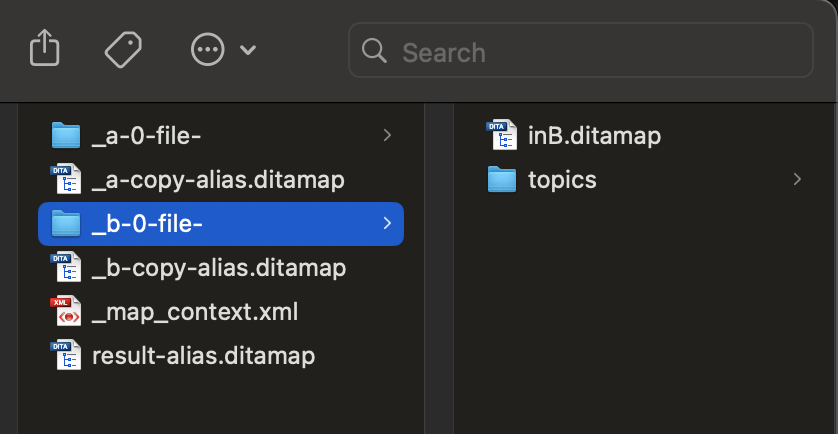
The response is a zip file that can be opened and output can typically be found under the _b-0-file- directory.
See more information about asynchronous comparison on this page.
Comparison Model
When specifying a comparison using XML or JSON structured requests, these are the various available objects:
|
Object |
Description |
|
|---|---|---|
|
inputA (required) |
Input A to the comparison. See this page for the various I/O types available. |
|
|
inputB (required) |
Input B to the comparison. See this page for the various I/O types available. |
|
|
configuration |
Configuration to the comparison See this page for more information on configuration files. See this page for the various I/O types available. |
|
|
catalog |
File path or HTTP URI pointing to catalog file(s). See this page for the various I/O types available. |
|
|
async |
output |
Specification of where the comparison result will be written. See this page for the various I/O types available. |
|
callback |
URL that will be polled after the comparison is complete. See Callbacks in Async for more information. |
|
Form Input
In addition to requests in structured XML or JSON format, multipart/form-data can also be used.
For example:
Request
POST /api/compare/dita/mts
Content-Type: multipart/form-data; boundary=boundary-id
Content-Length: number_of_bytes_in_entire_request_body

--boundary-id
Content-Disposition: form-data; name="inputA"; filename="inA.zip"
Content-Type: application/zip

--boundary-id
Content-Disposition: form-data; name="masterMapA"

inA/inA.ditamap

--boundary-id
Content-Disposition: form-data; name="inputB"; filename="inB.zip"
Content-Type: application/zip

--boundary-id
Content-Disposition: form-data; name="masterMapB"

inB/inB.ditamap
--boundary-id
Content-Disposition: form-data; name="async"
true
--boundary-id
The following table describes the parts that can make up the form-data:
|
Parameter |
Description and example usage |
|---|---|
|
inputA (required) |
Input A Can be specified in either a file path, a HTTP URI, or raw zip input |
|
masterMapA (required) |
Relative path to the unzipped master map for input A |
|
inputB (required) |
Input A Can be specified in either a file path, a HTTP URI, or raw zip input |
|
masterMapB (required) |
Relative path to the unzipped master map for input B |
|
catalog |
File path or HTTP URI pointing to catalog file(s). |
|
async |
Whether async comparison is used. Default value if not specified: false |
|
output |
An optional file path to write the output to when using async. E.g. "/Users/exampleUser/Documents/test.xml" |
|
callback |
Callback URL called after comparison is complete. Note : only used with asynchronous comparisons. See this page. |